
Bronze
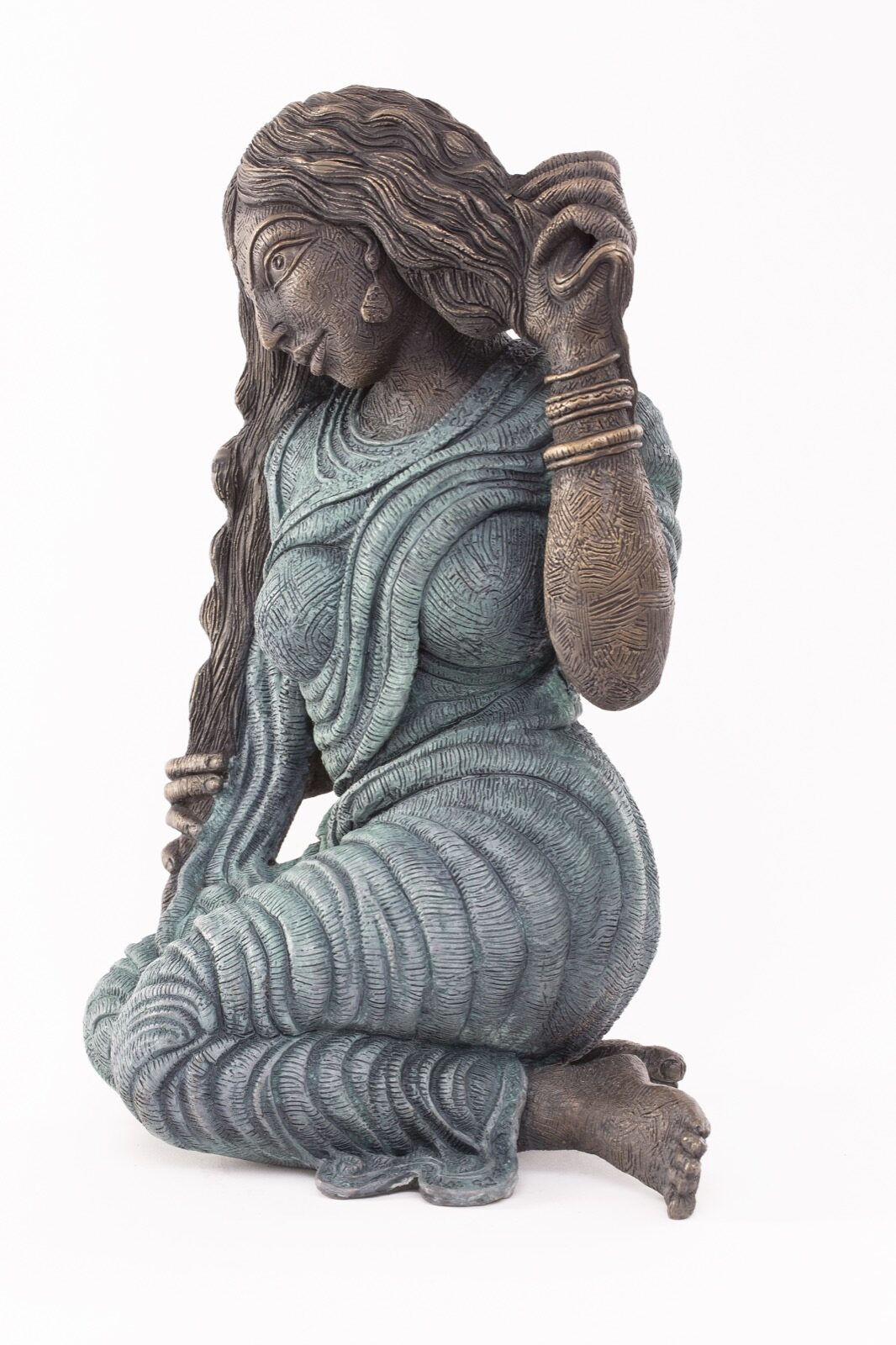
Jogen Chowdhury’s sinuous contour line is among the most recognisable signatures in Indian art—wrapping his figures in a slow, deliberate ink-and-pastel language that has now found its way into bronze.
Born in 1939 near Kotalipara in Faridpur district (now Bangladesh), Chowdhury studied at the Government College of Art & Craft, Kolkata (1955–60), before continuing in Paris at the École des Beaux-Arts and William Hayter’s Atelier 17, returning to India in 1967. He worked as a textile designer for the Madras Handloom Board from 1968, joined the Calcutta Painters Group in 1970, and in 1987 became Professor of Painting at Kala Bhavana, Santiniketan, where he continues to live and work.
His men and women—flaccid, swollen, caught in enigmatic postures within a dark dream-space—are modelled with dense cross-hatching and an unbroken outline. The work confronts violence, poverty, and inequality, yet insists on hope: “I want my paintings,” he has said, “to be like sunlight in the darkness.”
A retrospective of his work was mounted at the National Gallery of Modern Art, New Delhi, in 2012, and in 2019 he unveiled his accumulated lifetime body of work at the Jogen Chowdhury Centre for Arts, Kolkata, which he founded and which also hosts artist residencies. He was awarded the Padma Shri in 2004 and the Padma Bhushan in 2014.