
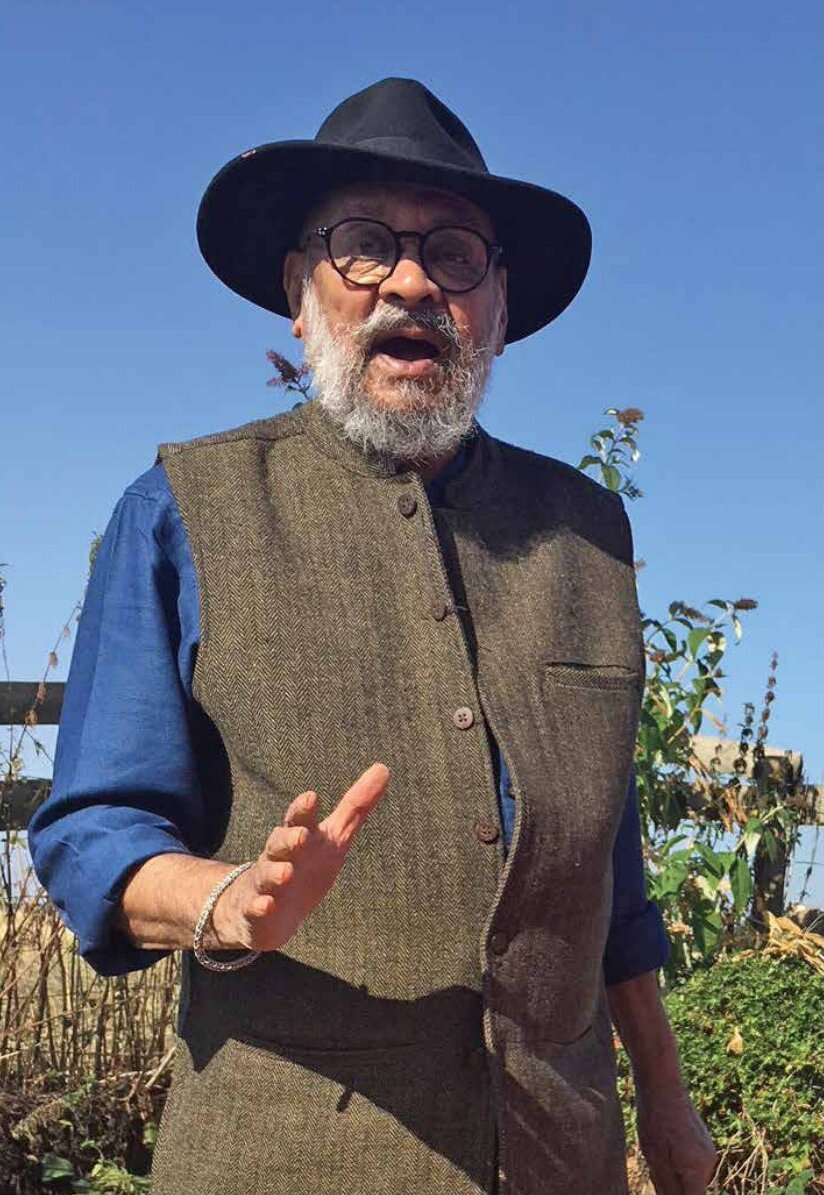
A founding member of Group 1890 and one of Indian sculpture’s most singular voices, Himmat Shah spent six decades interrogating material itself—clay, plaster, bronze, and paper—with tools of his own design.
Born in 1933 in Lothal, Gujarat—the site of the ancient Harappan port—Shah first trained as a drawing teacher before studying painting at the Faculty of Fine Arts, M.S. University, Baroda (1956–60) under N.S. Bendre. In 1962 he joined J. Swaminathan in founding Group 1890, whose sole exhibition (New Delhi, 1963) was inaugurated by Prime Minister Nehru. A French Government scholarship took him to Atelier 17, Paris, in 1967 to study etching under S.W. Hayter.
Though profoundly versatile—burnt-paper collages, silver paintings, drawings—Shah is best known as a sculptor. From 1967 to 1971 he designed monumental murals in brick, cement, and concrete at St. Xavier’s School, Ahmedabad, before turning to relief and sculpture in plaster, terracotta, ceramic, and bronze. His celebrated heads—incised with unreadable hieroglyphs, scarred and burnished—meditate on texture, age, and decay. He lived and worked in Jaipur.
His work was shown at the Biennale de Paris (1967, 1970), the Middelheim Biennale, Antwerp (1975), and the Ninth Triennale at NGMA, New Delhi (1997), with the major retrospective Hammer on the Square at the Kiran Nadar Museum of Art, New Delhi, in 2016. His honours include Lalit Kala National Awards (1959, 1962), the Sahitya Kala Parishad Award (1988), the AIFACS Award (1996), and the Kalidasa Samman (2003).